 Gravel2Gavel Construction & Real Estate Law Blog





As we previously reported, New Mexico adopted novel product labeling requirements that would require manufacturers to display a PFAS flask symbol on covered products. Those requirements are now on hold. A coalition of industry associations led by the American Chemistry Council sued in federal court, arguing that the mandate unconstitutionally compels speech in violation of the First Amendment. On September 16, 2026, the U.S. District Court for the District of New Mexico preliminarily enjoined enforcement of the labeling rule while the case, American Chemistry Council v. Kenney, No. 1:26-cv-02130-MIS-SCY, proceeds. The court found the challengers likely to succeed because New Mexico had not shown a reasonable fit between the label and its interests in protecting consumer health and the environment.
A Broad Rule Built Around One Symbol
New Mexico enacted its PFAS Protection Act in April 2025, joining Maine and Minnesota as the third state to adopt broad reporting requirements and eventual sales restrictions for products containing intentionally added per- and polyfluoroalkyl substances (PFAS). The Act also authorized the Environmental Improvement Board to require PFAS labels on products. The Board’s implementing rule, which became effective July 1, 2026, specified the exact format of the label and how it had to appear.
For most products manufactured after January 1, 2027, the rule required an outline of an Erlenmeyer flask with the word “PFAS” inside. The symbol had to appear on the product and, when packaging obscured it, on the package as well. Online and catalog sellers also had to display the disclosure before purchase. For complex durable goods—manufactured products, such as vehicles and HVAC systems, that have at least 100 components, are intended to last five years or more, and are not typically consumed, destroyed or discarded after one use—the symbol instead had to appear in the product specification sheet and the operation and maintenance manual.
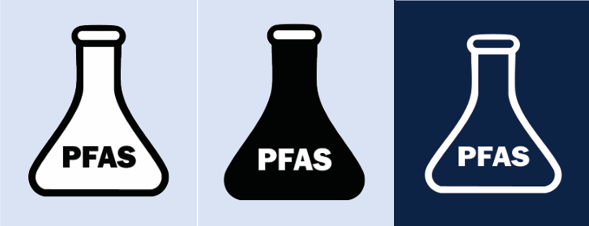
The breadth of the rule came from its product coverage. While other states limit their PFAS-label requirements to certain cookware or specific product categories, New Mexico’s rule was the first to require a label on any product containing intentionally added PFAS, regardless of category. Its labeling exemptions were limited to used products, certain pesticide products governed by federal labeling requirements, regulated veterinary products and their packaging, and FDA-regulated drugs and medical devices and their packaging.
The Limits of a Non-Warning Label
The challengers argued that the rule compelled commercial speech. The court applied Zauderer v. Office of Disciplinary Counsel, 471 U.S. 626 (1985), which permits certain compelled commercial disclosures that are purely factual and uncontroversial, reasonably related to the government’s interest, and not unjustified or unduly burdensome.
The court was not persuaded by the challengers’ threshold arguments that the label was not purely factual and was controversial. Although PFAS definitions vary and individual PFAS do not share the same properties or risks, the label conveyed only that a product contained a substance within New Mexico’s defined class. The flask image did not alter that factual message because it was not inherently inflammatory, and the plaintiffs had not shown that consumers understood it as a hazard warning. Nor did scientific disagreement about the effects of different PFAS make the disclosure controversial because the symbol said nothing about toxicity, risk or environmental effects.
That conclusion, however, did not end the inquiry. New Mexico relied on consumer health and environmental protection to justify the mandate but repeatedly defended the symbol as a neutral consumer awareness label rather than a warning. The court found no reasonable fit between those interests and a symbol that gave consumers no information about risk, exposure, handling or disposal.
The record sharpened that problem. The State’s expert called the flask a “single, uniform warning,” and an NMED webpage told consumers to “look for warnings about PFAS in products.” In the court’s view, the rule could not operate as a warning while being defended as a symbol that conveyed no warning. The court therefore found the challengers likely to succeed under the relatively deferential standard. The court took no position, however, on whether a hypothetical warning label would satisfy Zauderer, noting that such a label was not before it.
The court also found irreparable harm based on the threatened loss of First Amendment rights rather than the challengers’ asserted compliance costs, reasoning that even a brief infringement of those rights may support preliminary relief.
What Still Applies: Reporting and Sales Bans
The injunction bars enforcement of the labeling mandate while the federal case proceeds but leaves the Act’s reporting and sales restrictions, along with the rules implementing them, in force. The case will now proceed on the merits, with the court’s ruling on New Mexico’s pending motion to dismiss still to come. New Mexico may also seek interlocutory review in the Tenth Circuit.
On September 25, New Mexico filed a reply brief asking the court to reconsider its reasoning on the reasonable fit analysis. The State argued that the label need not itself contain a warning to satisfy rational basis scrutiny—what matters is whether the disclosure furthers the State’s interests, not what the label says. According to New Mexico, by enabling consumers to identify and avoid PFAS products, the label inherently serves its public health and environmental protection interests. The State has also indicated it is weighing additional options, including revising the rule to address the court’s concerns or appealing the ruling.
For manufacturers, the result is a partial reprieve rather than a broader pause in implementation. Absent an exemption, waiver or extension, reports remain due January 1, 2027, and must include a description of each covered product and the purpose, identity and concentration of each intentionally added PFAS. The first prohibitions on sale, offer for sale, or distribution also take effect that day for cookware, food packaging, dental floss, juvenile products and firefighting foam containing intentionally added PFAS. Additional categories follow in 2028, and the broader prohibition begins in 2032, subject to statutory exemptions and currently unavoidable use determinations. Nothing in the federal order alters those deadlines or the processes governing relief from those requirements.
Looking Ahead
The injunction provides immediate relief from New Mexico’s labeling mandate, but the State’s reporting deadline and product restrictions remain in effect. It therefore pauses one element of New Mexico’s PFAS program without altering the broader trend toward state regulation of PFAS in products.
The decision may influence challenges to related rules, but its reach is limited. The court found the challengers likely to succeed because New Mexico did not establish a reasonable fit between its asserted interests and the particular message it compelled. A different disclosure or administrative record could produce a different result, and future disputes likely will turn on whether the required message bears a reasonable relationship to the government’s stated purpose.
Pillsbury’s Environmental team will continue to monitor the litigation and NMED guidance. Please contact the authors with questions about particular products or coordinating PFAS requirements across states.